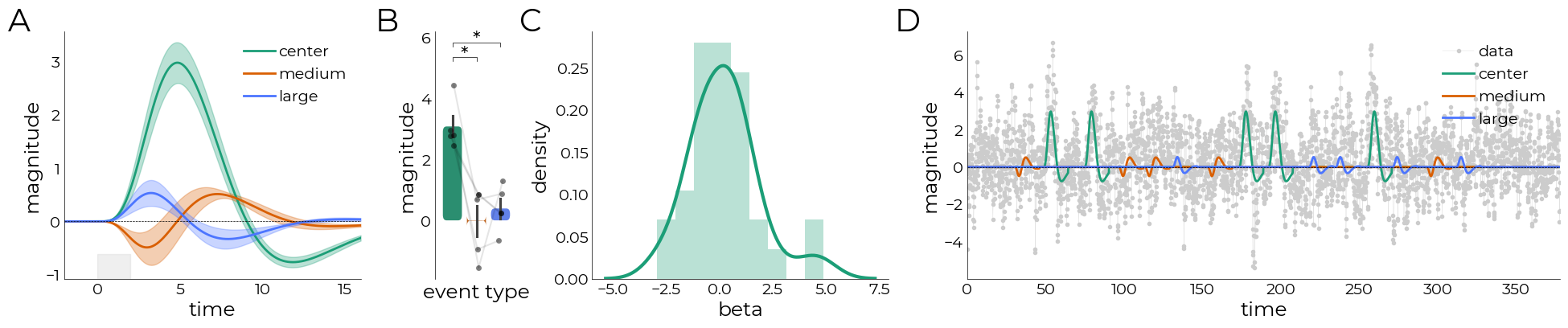
Using the lazyfmri-package
This notebook shows a couple of functionalities of the lazyfmri-package, including reading in data, plotting + statistics, and deconvolution procedures.
[1]:
from lazyfmri import (
    plotting,
    glm,
    utils,
    fitting,
    dataset,
    preproc
)
import pingouin as pg
import os
import pandas as pd
import matplotlib.pyplot as plt
opj = os.path.join
opd = os.path.dirname
Dataset: Read data
[3]:
data_dir = opj(opd(plotting.__file__), "data")
os.listdir(data_dir)
[3]:
['df_metrics.png',
 'profiles.csv',
 'df_func.png',
 'glms.csv',
 'df_onsets.png',
 'sub-01_ses-1_task-SRF_events.tsv',
 'betas.csv',
 'sub-01_ses-1_task-SRF_bold.mat',
 'sub-01_ses-1_task-SRF_eye.edf',
 'example.png']
[4]:
func = opj(data_dir, "sub-01_ses-1_task-SRF_bold.mat")
tsv = opj(data_dir, "sub-01_ses-1_task-SRF_events.tsv")
edf = opj(data_dir, "sub-01_ses-1_task-SRF_eye.edf")
t = dataset.Dataset(
    func,
    tsv_file=tsv,
    # edf_file=edf,
    verbose=True,
    phase_onset=0,
    ica=True,
    merge=False,
)
DATASET

FUNCTIONAL
Preprocessing /Users/heij/miniconda3/lib/python3.9/site-packages/lazyfmri/data/sub-01_ses-1_task-SRF_bold.mat
 Filtering strategy: 'hp'
 Standardization strategy: 'psc'
 Baseline is 20 seconds, or 190 TRs
 Cutting 0 vols from beginning (also cut from baseline (was 190, now 190 TRs) | 0 vols from end
 DCT-high pass filter [removes low frequencies <0.01 Hz] to correct low-frequency drifts.
 Running FastICA with 5 components
 DCT high-pass filter on components [removes low frequencies <0.2 Hz]
 Regressing out all high-passed components [>0.2 Hz]
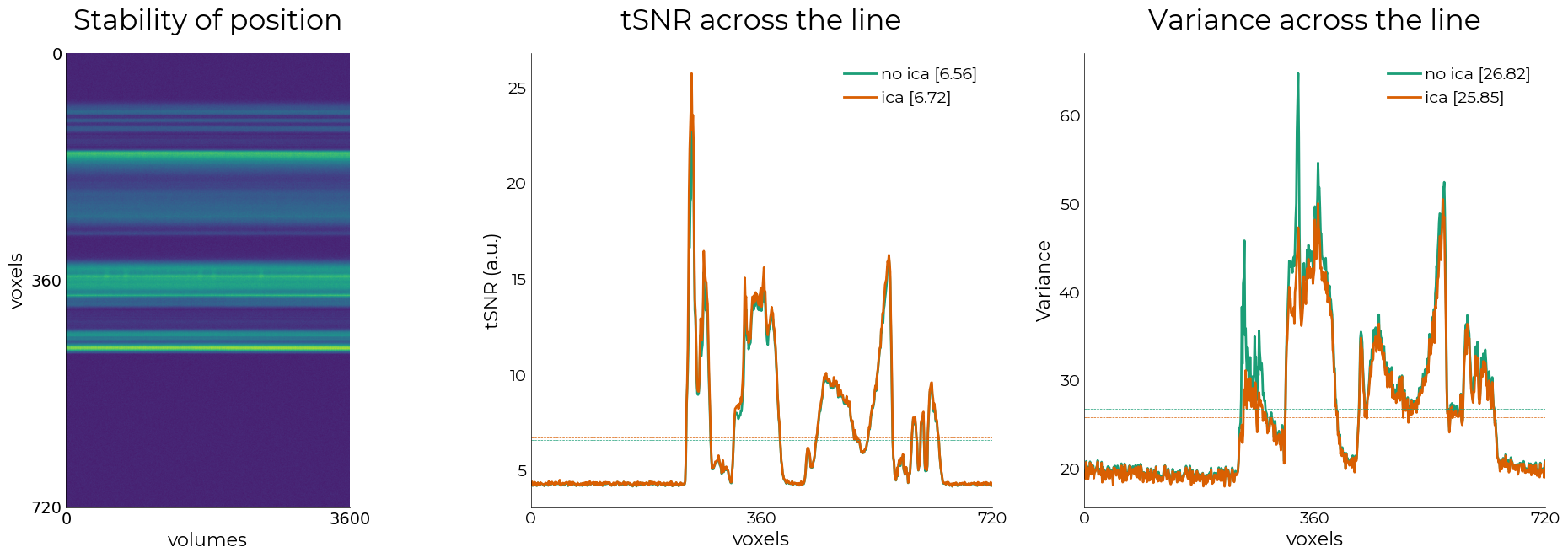
 tSNR [before 'ica']: 6.56      | variance: 26.82
 tSNR [after 'ica']:  6.72      | variance: 25.85

EXPTOOLS
Preprocessing /Users/heij/miniconda3/lib/python3.9/site-packages/lazyfmri/data/sub-01_ses-1_task-SRF_events.tsv
 1st 't' @37.13s
 Extracting ['b'] button(s)
 Cutting 37.13s from onsets

DATASET: created
[5]:
t.basic_qa(
    t.ts_corrected,
    run=1,
    make_figure=True
)
 tSNR [before 'ica']: 6.56      | variance: 26.82
 tSNR [after 'ica']:  6.72      | variance: 25.85
[6]:
# preprocessed functional data (high-pass + ICA [5 comps])
t.fetch_fmri().head()
Fetching dataframe from attribute 'df_func_ica'
[6]:
| vox 0 | vox 1 | vox 2 | vox 3 | vox 4 | vox 5 | vox 6 | vox 7 | vox 8 | vox 9 | ... | vox 710 | vox 711 | vox 712 | vox 713 | vox 714 | vox 715 | vox 716 | vox 717 | vox 718 | vox 719 | |||
|---|---|---|---|---|---|---|---|---|---|---|---|---|---|---|---|---|---|---|---|---|---|---|---|
| subject | run | t | |||||||||||||||||||||
| 01 | 1 | 0.000 | 24.120995 | 26.884232 | -6.523682 | -13.212769 | -26.410553 | 5.315056 | 38.903366 | -3.039337 | 32.551918 | -0.393822 | ... | 35.238266 | 68.940781 | -46.369797 | -12.008331 | 2.939903 | 41.984879 | 14.404648 | 10.435143 | 17.629280 | -18.974892 |
| 0.105 | 60.904526 | -4.066513 | -5.549294 | 10.578300 | -31.444527 | -13.776810 | 9.944603 | -11.358437 | 31.305672 | 7.784973 | ... | 29.101364 | -1.237228 | 42.155609 | 2.658195 | 33.851700 | -17.355743 | 15.824417 | 20.952255 | 28.794029 | 20.434402 | ||
| 0.210 | -10.842644 | -29.055435 | 15.535713 | -36.002487 | 15.479706 | -7.587608 | -1.707916 | 12.058693 | -16.157364 | -7.403816 | ... | -18.747169 | -31.623734 | -4.397873 | 79.508301 | 29.455460 | -18.974419 | -1.437408 | 45.921638 | -24.293541 | 8.289619 | ||
| 0.315 | -22.451355 | -3.198708 | 1.316246 | -10.250626 | -12.907562 | -26.392105 | 7.321220 | 50.494308 | 0.506996 | 22.063896 | ... | -14.635651 | -3.495102 | 5.431557 | -13.444511 | -14.753075 | -8.381844 | -13.837997 | 27.244171 | -5.284363 | -31.195488 | ||
| 0.420 | -4.934433 | 1.994728 | 50.188454 | 29.976830 | 4.476112 | 9.072395 | -2.892616 | 23.413216 | -50.936028 | 16.053589 | ... | 19.833023 | 1.415779 | 4.240707 | 38.267975 | 15.010330 | 12.893593 | -4.238487 | 62.481651 | -34.293571 | -0.052536 |
5 rows × 720 columns
[7]:
# event onsets
t.df_onsets.head()
[7]:
| onset | |||
|---|---|---|---|
| subject | run | event_type | |
| 01 | 1 | suppr_1 | 30.016442 |
| act | 48.358001 | ||
| act | 74.357842 | ||
| suppr_1 | 96.282811 | ||
| suppr_1 | 113.007627 |
NideconvFitter: deconvolve data
You can either input your entire dataset in the fitter, or select a subset of the dataframe using utils.select_from_df() based on the columns (used indices=[354,360]) or rows/index (expression="index = value"):
[8]:
# select particular run
func = utils.select_from_df(
    t.fetch_fmri(),
    expression="run = 1"
)
func.head()
Fetching dataframe from attribute 'df_func_ica'
[8]:
| vox 0 | vox 1 | vox 2 | vox 3 | vox 4 | vox 5 | vox 6 | vox 7 | vox 8 | vox 9 | ... | vox 710 | vox 711 | vox 712 | vox 713 | vox 714 | vox 715 | vox 716 | vox 717 | vox 718 | vox 719 | |||
|---|---|---|---|---|---|---|---|---|---|---|---|---|---|---|---|---|---|---|---|---|---|---|---|
| subject | run | t | |||||||||||||||||||||
| 01 | 1 | 0.000 | 24.120995 | 26.884232 | -6.523682 | -13.212769 | -26.410553 | 5.315056 | 38.903366 | -3.039337 | 32.551918 | -0.393822 | ... | 35.238266 | 68.940781 | -46.369797 | -12.008331 | 2.939903 | 41.984879 | 14.404648 | 10.435143 | 17.629280 | -18.974892 |
| 0.105 | 60.904526 | -4.066513 | -5.549294 | 10.578300 | -31.444527 | -13.776810 | 9.944603 | -11.358437 | 31.305672 | 7.784973 | ... | 29.101364 | -1.237228 | 42.155609 | 2.658195 | 33.851700 | -17.355743 | 15.824417 | 20.952255 | 28.794029 | 20.434402 | ||
| 0.210 | -10.842644 | -29.055435 | 15.535713 | -36.002487 | 15.479706 | -7.587608 | -1.707916 | 12.058693 | -16.157364 | -7.403816 | ... | -18.747169 | -31.623734 | -4.397873 | 79.508301 | 29.455460 | -18.974419 | -1.437408 | 45.921638 | -24.293541 | 8.289619 | ||
| 0.315 | -22.451355 | -3.198708 | 1.316246 | -10.250626 | -12.907562 | -26.392105 | 7.321220 | 50.494308 | 0.506996 | 22.063896 | ... | -14.635651 | -3.495102 | 5.431557 | -13.444511 | -14.753075 | -8.381844 | -13.837997 | 27.244171 | -5.284363 | -31.195488 | ||
| 0.420 | -4.934433 | 1.994728 | 50.188454 | 29.976830 | 4.476112 | 9.072395 | -2.892616 | 23.413216 | -50.936028 | 16.053589 | ... | 19.833023 | 1.415779 | 4.240707 | 38.267975 | 15.010330 | 12.893593 | -4.238487 | 62.481651 | -34.293571 | -0.052536 |
5 rows × 720 columns
[9]:
t.fetch_fmri()
Fetching dataframe from attribute 'df_func_ica'
[9]:
| vox 0 | vox 1 | vox 2 | vox 3 | vox 4 | vox 5 | vox 6 | vox 7 | vox 8 | vox 9 | ... | vox 710 | vox 711 | vox 712 | vox 713 | vox 714 | vox 715 | vox 716 | vox 717 | vox 718 | vox 719 | |||
|---|---|---|---|---|---|---|---|---|---|---|---|---|---|---|---|---|---|---|---|---|---|---|---|
| subject | run | t | |||||||||||||||||||||
| 01 | 1 | 0.000 | 24.120995 | 26.884232 | -6.523682 | -13.212769 | -26.410553 | 5.315056 | 38.903366 | -3.039337 | 32.551918 | -0.393822 | ... | 35.238266 | 68.940781 | -46.369797 | -12.008331 | 2.939903 | 41.984879 | 14.404648 | 10.435143 | 17.629280 | -18.974892 |
| 0.105 | 60.904526 | -4.066513 | -5.549294 | 10.578300 | -31.444527 | -13.776810 | 9.944603 | -11.358437 | 31.305672 | 7.784973 | ... | 29.101364 | -1.237228 | 42.155609 | 2.658195 | 33.851700 | -17.355743 | 15.824417 | 20.952255 | 28.794029 | 20.434402 | ||
| 0.210 | -10.842644 | -29.055435 | 15.535713 | -36.002487 | 15.479706 | -7.587608 | -1.707916 | 12.058693 | -16.157364 | -7.403816 | ... | -18.747169 | -31.623734 | -4.397873 | 79.508301 | 29.455460 | -18.974419 | -1.437408 | 45.921638 | -24.293541 | 8.289619 | ||
| 0.315 | -22.451355 | -3.198708 | 1.316246 | -10.250626 | -12.907562 | -26.392105 | 7.321220 | 50.494308 | 0.506996 | 22.063896 | ... | -14.635651 | -3.495102 | 5.431557 | -13.444511 | -14.753075 | -8.381844 | -13.837997 | 27.244171 | -5.284363 | -31.195488 | ||
| 0.420 | -4.934433 | 1.994728 | 50.188454 | 29.976830 | 4.476112 | 9.072395 | -2.892616 | 23.413216 | -50.936028 | 16.053589 | ... | 19.833023 | 1.415779 | 4.240707 | 38.267975 | 15.010330 | 12.893593 | -4.238487 | 62.481651 | -34.293571 | -0.052536 | ||
| ... | ... | ... | ... | ... | ... | ... | ... | ... | ... | ... | ... | ... | ... | ... | ... | ... | ... | ... | ... | ... | ... | ||
| 377.475 | -12.011627 | -27.804131 | -4.247818 | 3.850395 | 13.434708 | -13.325851 | -11.991318 | 48.694641 | -14.418465 | 17.417793 | ... | 11.003410 | 5.086433 | 9.591133 | 2.009270 | -1.192749 | -31.425163 | 19.871819 | 9.320839 | -31.430031 | -43.894890 | ||
| 377.580 | 0.978722 | 12.072548 | 1.603668 | 16.085312 | -8.246437 | -9.025551 | -13.306900 | 13.437164 | 21.946548 | -9.839020 | ... | -13.095047 | -42.527115 | 32.514877 | -12.019234 | 20.575027 | 23.909904 | -13.735153 | -39.035683 | -10.055534 | -11.766006 | ||
| 377.685 | -35.623386 | 9.984329 | 51.675240 | 1.970345 | 40.135155 | -20.763428 | 8.739861 | -10.021568 | 34.045082 | 0.650864 | ... | -23.774216 | -25.980812 | -27.767540 | -10.051491 | 39.635025 | 14.152061 | 16.660095 | 34.088905 | 18.116859 | -3.807968 | ||
| 377.790 | 37.096939 | -13.449570 | 17.217300 | -12.686440 | 11.852051 | 16.513260 | 3.448265 | 21.950768 | 23.538857 | -1.577194 | ... | -10.944649 | 12.543327 | -3.919037 | 3.668861 | 4.819633 | 9.076393 | 15.658363 | -12.369011 | -27.114166 | -22.759338 | ||
| 377.895 | -14.316536 | 14.075386 | 20.446785 | -9.932777 | 25.556366 | 5.452995 | 20.317551 | 32.211632 | 5.674583 | 7.165482 | ... | 2.156181 | 24.890739 | -15.975510 | 27.382568 | -13.209038 | -3.198730 | -20.116196 | -11.395653 | 21.581970 | 34.095779 |
3600 rows × 720 columns
[10]:
# select columns
func = utils.select_from_df(
    t.fetch_fmri(),
    indices=(358,363)
)
func.head()
Fetching dataframe from attribute 'df_func_ica'
[10]:
| vox 358 | vox 359 | vox 360 | vox 361 | vox 362 | |||
|---|---|---|---|---|---|---|---|
| subject | run | t | |||||
| 01 | 1 | 0.000 | -13.839142 | -0.588173 | -8.102196 | -2.139931 | 4.546173 |
| 0.105 | -15.945457 | -1.409012 | 9.016457 | -4.400345 | -0.167259 | ||
| 0.210 | 3.386215 | -2.018135 | -1.606422 | 3.617538 | -4.278763 | ||
| 0.315 | 4.105896 | -4.456375 | -5.251724 | 7.006035 | 1.271133 | ||
| 0.420 | 16.345734 | -4.209183 | -5.079575 | 0.242401 | -9.488388 |
[11]:
# initialize the fitter
dec = fitting.NideconvFitter(
    func,
    t.fetch_onsets(),
    basis_sets="canonical_hrf_with_time_derivative",
    TR=0.105,
    interval=[-2,16],
    verbose=True,
    conf_intercept=False
)

dec.timecourses_condition()
Selected 'canonical_hrf_with_time_derivative'-basis sets (with 2 regressors)
Adding event 'act' to model
Adding event 'suppr_1' to model
Adding event 'suppr_2' to model
Fitting with 'ols' minimization
Fitting completed
Fetching subject/condition-wise time courses from <nideconv.group_analysis.GroupResponseFitter object at 0x13aa04a90>
[12]:
# average over the voxels and parse into list
evs = utils.get_unique_ids(dec.tc_condition, id="event_type")

tc,se,pr = [],[],[]
for i in evs:
    avg = utils.select_from_df(
        dec.tc_condition,
        expression=f"event_type = {i}"
    )

    pred = utils.select_from_df(
        dec.ev_predictions,
        expression=f"event_type = {i}"
    )

    tc.append(avg.mean(axis=1).values)
    se.append(avg.sem(axis=1).values)
    pr.append(pred.mean(axis=1).values)
LazyLine: plot simple lines
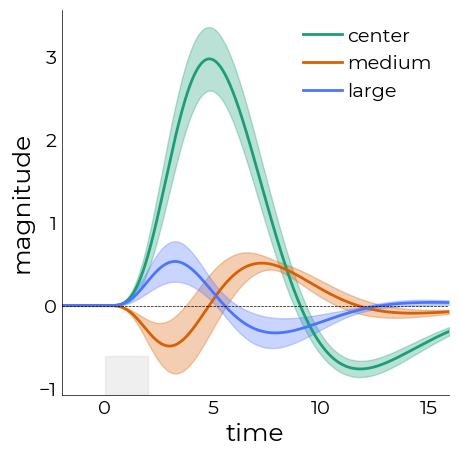
[13]:
%matplotlib inline

# do some plotting
pl = plotting.LazyLine(
    tc,
    xx=dec.time,
    figsize=(5,5),
    color=["#1B9E77","#D95F02","#4c75ff"],
    error=se,
    line_width=2,
    labels=["center","medium","large"],
    x_label="time",
    y_label="magnitude",
    add_hline=0
)

plotting.add_axvspan(
    pl.axs,
    ymax=0.1
)
[16]:
%matplotlib inline

# do some plotting
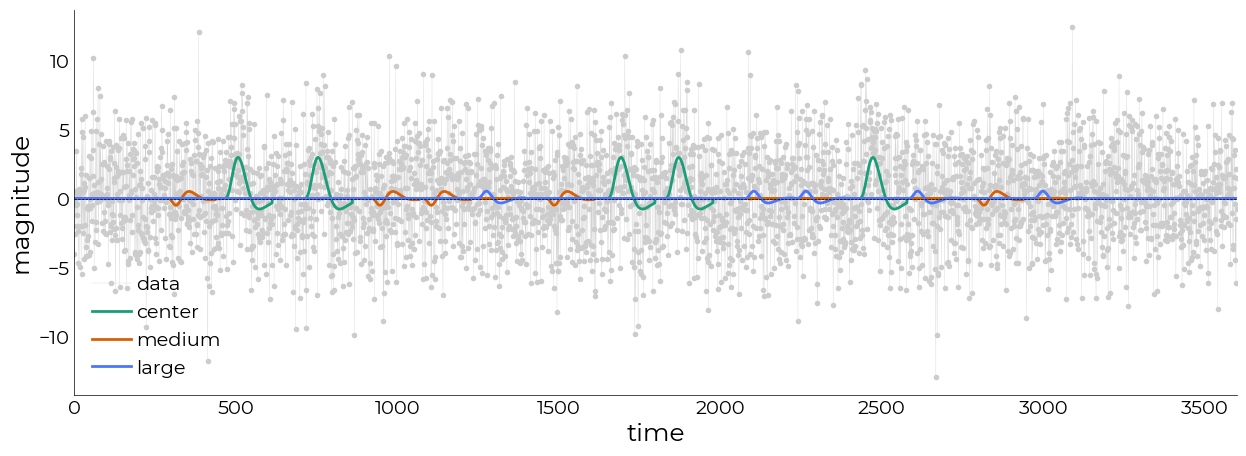
pl = plotting.LazyLine(
    [dec.func.mean(axis=1).values]+pr,
    figsize=(15,5),
    color=["#cccccc","#1B9E77","#D95F02","#4c75ff"],
    line_width=[0.2,2,2,2],
    labels=["data","center","medium","large"],
    x_label="time",
    y_label="magnitude",
    add_hline=0,
    markers=[".", None, None, None]
)
DataFilter: apply filter to entire dataframe
[17]:
%matplotlib inline

filt = preproc.DataFilter(
    dec.func,
    filter_strategy="lp"
)

# initialize the fitter
dec = fitting.NideconvFitter(
    filt.df_filt,
    t.fetch_onsets(),
    basis_sets="canonical_hrf_with_time_derivative",
    TR=0.105,
    interval=[-2,16],
    verbose=True,
    conf_intercept=False
)

dec.timecourses_condition()

# average over the voxels and parse into list
evs = utils.get_unique_ids(dec.tc_condition, id="event_type")

tc,se,pr = [],[],[]
for i in evs:
    avg = utils.select_from_df(
        dec.tc_condition,
        expression=f"event_type = {i}"
    )

    pred = utils.select_from_df(
        dec.ev_predictions,
        expression=f"event_type = {i}"
    )

    tc.append(avg.mean(axis=1).values)
    se.append(avg.sem(axis=1).values)
    pr.append(pred.mean(axis=1).values)


# do some plotting
pl = plotting.LazyLine(
    [dec.func.mean(axis=1).values]+pr,
    xx=utils.get_unique_ids(dec.func, id="t"),
    figsize=(15,5),
    color=["#cccccc","#1B9E77","#D95F02","#4c75ff"],
    line_width=[0.2,2,2,2],
    labels=["data","center","medium","large"],
    x_label="time",
    y_label="magnitude",
    add_hline=0,
    markers=[".", None, None, None],
    title={
        "title": "low-pass filtered predictions",
        "fontweight": "bold"
    }
)
Selected 'canonical_hrf_with_time_derivative'-basis sets (with 2 regressors)
Adding event 'act' to model
Adding event 'suppr_1' to model
Adding event 'suppr_2' to model
Fitting with 'ols' minimization
Fitting completed
Fetching subject/condition-wise time courses from <nideconv.group_analysis.GroupResponseFitter object at 0x13ab71990>
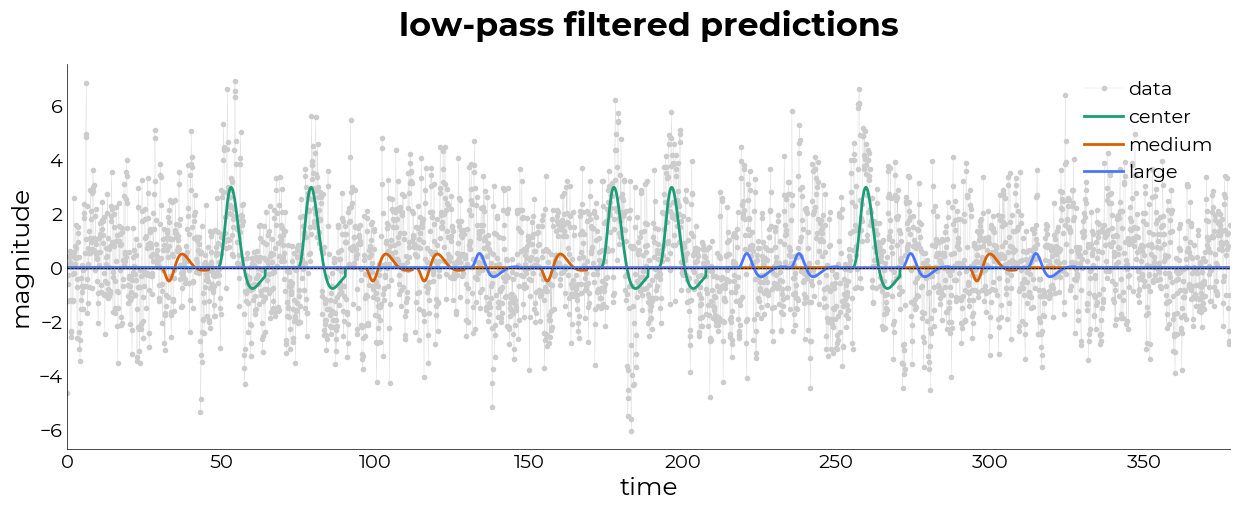
These classes also have the capability to extract relevant information from the deconvolved HRF profiles. The success of the estimation depends on the basis sets used and the quality of the data.
[18]:
dec.parameters_for_tc_subjects()
dec.pars_subjects.head()
Deriving parameters from <lazyfmri.fitting.NideconvFitter object at 0x13a836980> with 'HRFMetrics'
[18]:
| magnitude | magnitude_ix | fwhm | fwhm_obj | time_to_peak | half_rise_time | half_max | rise_slope | onset_time | positive_area | undershoot | 1st_deriv_magnitude | 1st_deriv_time_to_peak | 2nd_deriv_magnitude | 2nd_deriv_time_to_peak | ||||
|---|---|---|---|---|---|---|---|---|---|---|---|---|---|---|---|---|---|---|
| subject | event_type | run | vox | |||||||||||||||
| 01 | act | 1 | vox 358 | 2.467425 | 1485 | 4.364710 | <lazyfmri.fitting.FWHM object at 0x13ac59720> | 5.798530 | 3.805654 | 1.233713 | 1.005427 | 2.585273 | 10.658189 | 2.815127 | -0.115784 | 1.192934 | -0.174174 | 0.741302 |
| vox 359 | 2.800170 | 1206 | 4.145993 | <lazyfmri.fitting.FWHM object at 0x13ac5a1d0> | 4.333352 | 2.446804 | 1.400085 | 1.182195 | 1.263848 | 11.574219 | 3.700148 | 1.241342 | 2.421793 | 0.918949 | 1.313719 | |||
| vox 360 | 2.781102 | 1197 | 4.108069 | <lazyfmri.fitting.FWHM object at 0x13ac5ad70> | 4.286088 | 2.419824 | 1.390551 | 1.186402 | 1.249143 | 11.390945 | 3.689496 | 1.246229 | 2.395535 | 0.932820 | 1.297964 | |||
| vox 361 | 2.950976 | 1328 | 4.450755 | <lazyfmri.fitting.FWHM object at 0x13ac58f40> | 4.974039 | 2.909469 | 1.475488 | 1.110632 | 1.579637 | 13.111810 | 3.737924 | 1.166981 | 2.920689 | 0.735578 | 1.670823 | |||
| vox 362 | 4.426424 | 1316 | 4.438020 | <lazyfmri.fitting.FWHM object at 0x13ac5b4c0> | 4.911021 | 2.855035 | 2.213212 | 1.677232 | 1.534549 | 19.605648 | 5.632660 | 1.762065 | 2.857670 | 1.125011 | 1.618308 |
LazyBar: barplots including significance bars
[19]:
# which we can then flop into a LazyBar-object
br = plotting.LazyBar(
    dec.pars_subjects,
    figsize=(2,5),
    x="event_type",
    y="magnitude",
    sns_offset=4,
    fancy=True,
    x_label="event type",
    y_label="magnitude",
    connect=True,
    points_color="k",
    points_alpha=0.5,
    palette=["#1B9E77","#D95F02","#4c75ff"],
    lbl_legend=["center","medium","large"],
    bar_legend=True,
    bbox_to_anchor=(0.8,1)
)

# add the stats
normality = pg.normality(br.data[br.y])
is_normal = normality["normal"][0]

aov = glm.ANOVA(
    data=br.data,
    dv=br.y,
    between=br.x,
    # test="test",
    parametric=is_normal,
    posthoc_kw={
        "effsize": "cohen",
        "test": "test",
        "paired": True,
        "subject": "vox",
        "padjust": "holm"
    }
)

aov.plot_bars(
    axs=br.ff,
    ast_frac=0,
    y_pos=1.15,
    line_separate_factor=-0.075
)

print("\n", normality)
print("\n", aov.ano)
print("\n", aov.posthoc_sorted)
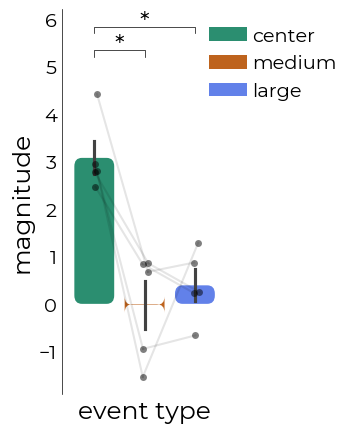
                   W      pval  normal
magnitude  0.961831  0.724179    True

        Source  ddof1  ddof2          F     p-unc      np2
0  event_type      2     12  17.535832  0.000274  0.74507

      Contrast        A        B  Paired  Parametric         T  dof  \
1  event_type      act  suppr_2    True        True  5.036345  4.0
0  event_type      act  suppr_1    True        True  6.173944  4.0
2  event_type  suppr_1  suppr_2    True        True -0.784411  4.0

  alternative     p-unc    p-corr p-adjust   BF10     cohen  distances
1   two-sided  0.007301  0.014602     holm  8.849  3.556338          2
0   two-sided  0.003496  0.010487     holm   15.1  3.202325          1
2   two-sided  0.476649  0.476649     holm  0.505 -0.438658          1
LazyHist: plot histograms
[111]:
glms = pd.read_csv(opj(data_dir,"glms.csv"), usecols=lambda column: not column.startswith("Unnamed"))
[112]:
color = "#1B9E77"
hist = plotting.LazyHist(
    utils.multiselect_from_df(
        glms,
        expression=[
            "preproc = corr",
            "method = norm",
            "model = camel_deriv"
        ]
    )["beta"],
    figsize=(5,5),
    kde=True,
    color=color,
    kde_kwargs={
        "linewidth": 3,
    },
    hist_kwargs={
        "alpha": 0.3,
        "fc": color
    },
    x_label="beta",
    y_label="density"
)
ParameterFitter: estimate parameters from double-gamma HRF
The double-gamma HRF can also be described by a set of parameters (7), rather than a set of basissets that is used for deconvolution. Similar to pRF fitting, this becomes an optimization procedure. This class iteratively assesses the best combination of parameters that mimimizes the error between the prediction the HRF generates and the actual data.
[ ]:
par = fitting.ParameterFitter(
    filt.df_filt,
    t.fetch_onsets()
)

par.fit(
    osf=1, # higher values slow down the convolution process, but are more accurate wrt the onsets
    verbose=True,
    n_jobs=None # "None" sets the number of jobs to the number of input voxels.. be careful with a large number of voxels. Use an integer value to constrain the process to a certain number of jobs.
)
[Parallel(n_jobs=5)]: Using backend LokyBackend with 5 concurrent workers.
[Parallel(n_jobs=5)]: Done   2 out of   5 | elapsed:   24.7s remaining:   37.1s
[Parallel(n_jobs=5)]: Done   5 out of   5 | elapsed:   49.8s finished
[Parallel(n_jobs=5)]: Using backend LokyBackend with 5 concurrent workers.
[Parallel(n_jobs=5)]: Done   2 out of   5 | elapsed:   21.9s remaining:   32.9s
[Parallel(n_jobs=5)]: Done   5 out of   5 | elapsed:   45.0s finished
[Parallel(n_jobs=5)]: Using backend LokyBackend with 5 concurrent workers.
[Parallel(n_jobs=5)]: Done   2 out of   5 | elapsed:   20.6s remaining:   30.8s
[Parallel(n_jobs=5)]: Done   5 out of   5 | elapsed:   35.8s finished
[98]:
# from this, we can extract estimates of individual parameter estimates that generate the full HRF
par.estimates.head()
[98]:
| a1 | a2 | b1 | b2 | c | d1 | d2 | ||||
|---|---|---|---|---|---|---|---|---|---|---|
| subject | event_type | run | vox | |||||||
| 01 | act | 1 | vox 358 | 7.999986 | 10.000003 | 1.158610 | 0.800000 | 0.488982 | 4.907072 | 14.959780 |
| vox 359 | 4.911836 | 10.564334 | 1.076591 | 0.800003 | 0.402760 | 9.999969 | 13.874413 | |||
| vox 360 | 4.176546 | 11.129979 | 1.199997 | 0.800005 | 0.365645 | 9.651971 | 14.378838 | |||
| vox 361 | 4.000091 | 13.686921 | 1.199999 | 0.800004 | 0.416347 | 2.082332 | 13.708682 | |||
| vox 362 | 6.042051 | 12.164910 | 0.869612 | 0.800002 | 0.445467 | 9.999975 | 14.638781 |
[99]:
# similar to deconvolution, we can call this function to extract relevant parameters from the HRF generated with the estimates
par.parameters_for_tc_subjects()
par.pars_subjects.head()
[99]:
| magnitude | magnitude_ix | fwhm | fwhm_obj | time_to_peak | half_rise_time | half_max | rise_slope | onset_time | positive_area | undershoot | 1st_deriv_magnitude | 1st_deriv_time_to_peak | 2nd_deriv_magnitude | 2nd_deriv_time_to_peak | ||||
|---|---|---|---|---|---|---|---|---|---|---|---|---|---|---|---|---|---|---|
| subject | event_type | run | vox | |||||||||||||||
| 01 | act | 1 | vox 358 | 2.350515 | 7 | 4.289343 | <lazyplot.fitting.FWHM object at 0x138ac9850> | 7.241379 | 5.075891 | 1.171200 | 0.753576 | 3.521701 | 9.092618 | 5.176764 | 0.761063 | 5.172414 | 0.259572 | 4.137931 |
| vox 359 | 2.842579 | 5 | 4.125753 | <lazyplot.fitting.FWHM object at 0x13802b690> | 5.172414 | 2.697976 | 1.421168 | NaN | NaN | 11.232870 | 2.977184 | 1.029912 | 3.103448 | 0.400542 | 1.034483 | |||
| vox 360 | 2.753171 | 4 | 4.265000 | <lazyplot.fitting.FWHM object at 0x138019350> | 4.137931 | 2.507538 | 1.375451 | NaN | NaN | 11.225525 | 3.470401 | 0.925612 | 2.068966 | 0.392741 | 1.034483 | |||
| vox 361 | 2.870323 | 5 | 5.245565 | <lazyplot.fitting.FWHM object at 0x137febdd0> | 5.172414 | 2.483631 | 1.434844 | NaN | NaN | 14.913531 | 1.665688 | 0.947662 | 2.068966 | 0.389894 | 1.034483 | |||
| vox 362 | 4.602402 | 5 | 4.329915 | <lazyplot.fitting.FWHM object at 0x139e6cb50> | 5.172414 | 3.065600 | 2.298418 | 1.633259 | 1.658337 | 19.311170 | 3.876998 | 1.631864 | 3.103448 | 0.632060 | 2.068966 |
[105]:
# the output from the parameter fitter is the same as those from deconvolution using nideconv, so we can use the same code to generate plots
evs = utils.get_unique_ids(par.tc_condition, id="event_type")

tc1,se1,pr1 = [],[],[]
for i in evs:
    avg = utils.select_from_df(
        par.tc_condition,
        expression=f"event_type = {i}"
    )

    pred = utils.select_from_df(
        par.ev_predictions,
        expression=f"event_type = {i}"
    )

    tc1.append(avg.mean(axis=1).values)
    se1.append(avg.sem(axis=1).values)
    pr1.append(pred.mean(axis=1).values)
[107]:
%matplotlib inline

# do some plotting
pl = plotting.LazyLine(
    tc1,
    xx=utils.get_unique_ids(par.tc_condition, id="time"),
    figsize=(5,5),
    color=["#1B9E77","#D95F02","#4c75ff"],
    error=se1,
    line_width=2,
    labels=["center","medium","large"],
    x_label="time",
    y_label="magnitude",
    add_hline=0
)

plotting.add_axvspan(
    pl.axs,
    ymax=0.1
)
Summary Figure
[113]:
fig,axs = plt.subplots(
    ncols=4,
    width_ratios=[0.2,0.05,0.2,0.4],
    figsize=(24,4),
    gridspec_kw={
        "wspace": 0.25
    }
)

# LazyLine
pl = plotting.LazyLine(
    tc,
    xx=dec.time,
    axs=axs[0],
    color=["#1B9E77","#D95F02","#4c75ff"],
    error=se,
    line_width=2,
    labels=["center","medium","large"],
    x_label="time",
    y_label="magnitude",
    add_hline=0
)

plotting.add_axvspan(
    pl.axs,
    ymax=0.1
)

# LazyBar
br = plotting.LazyBar(
    dec.pars_subjects,
    axs=axs[1],
    x="event_type",
    y="magnitude",
    sns_offset=4,
    fancy=True,
    x_label="event type",
    y_label="magnitude",
    connect=True,
    points_color="k",
    points_alpha=0.5,
    palette=["#1B9E77","#D95F02","#4c75ff"],
    lbl_legend=["center","medium","large"],
)

# add the stats
normality = pg.normality(br.data[br.y])
is_normal = normality["normal"][0]

aov = glm.ANOVA(
    data=br.data,
    dv=br.y,
    between=br.x,
    # test="test",
    parametric=is_normal,
    posthoc_kw={
        "effsize": "cohen",
        "test": "test",
        "paired": True,
        "subject": "vox",
        "padjust": "holm"
    }
)

aov.plot_bars(
    axs=br.ff,
    ast_frac=-0.015,
    y_pos=1.15,
    line_separate_factor=-0.075
)

# LazyHist
plotting.LazyHist(
    utils.multiselect_from_df(
        glms,
        expression=[
            "preproc = corr",
            "method = norm",
            "model = camel_deriv"
        ]
    )["beta"],
    axs=axs[2],
    kde=True,
    color="#1B9E77",
    kde_kwargs={
        "linewidth": 3,
    },
    hist_kwargs={
        "alpha": 0.3,
        "fc": "#1B9E77"
    },
    x_label="beta",
    y_label="density"
)

# Timecourse (predictions)
pl = plotting.LazyLine(
    [dec.func.mean(axis=1).values]+pr,
    xx=utils.get_unique_ids(dec.func, id="t"),
    axs=axs[-1],
    color=["#cccccc","#1B9E77","#D95F02","#4c75ff"],
    line_width=[0.2,2,2,2],
    labels=["data","center","medium","large"],
    x_label="time",
    y_label="magnitude",
    add_hline=0,
    markers=[".", None, None, None],
)

plotting.fig_annot(
    fig,
    x0_corr=-0.7,
    x_corr=[-0.8,-0.9,-0.9],
    y=1
)

# fig.savefig(
#     opj(data_dir, "example.png"),
#     bbox_inches="tight",
#     dpi=300,
#     facecolor="white"
# )